
A champion
This is the first of a series of posts about riding the bike to lose weight. Throughout this discussion of losing weight it’s important to keep in mind that eating has many consequences for health, athletic performance and weight gain or loss. We’ll start by focusing purely on weight loss but it is very important to keep in mind that the “best” diet for losing weight is unlikely to be the “best” diet for maintaining your health or a high level of athletic performance.
A lot of people aren’t going to like these posts. I noted in a recent post that Americans spend about $50,000 on diet industry products and services every 80 seconds, 24/7/365. If you work for 50 years and average $50K a year, Americans spend more on diet stuff in an hour and 10 minutes than you will make in your entire life. 24/7/365. The people who are spending that money and the people who are raking in the cash from all that stuff are going to be especially unhappy with these posts. Why? Because if you’re riding your bike to lose weight, most of that stuff is a waste of time and money.
Many people get into riding the bike as a way to lose weight and others who are interested in the health benefits of riding have weight loss as a secondary goal. This is a good idea because riding the bike can be a great way to lose weight.
 There are a couple of ways to go about this. One approach is to focus your attention on losing weight. You buy diet books and scour the internet for info about losing weight. You pay careful attention to things like how many calories there are per serving size. You count calories for each meal and snack. You weigh yourself obsessively. You may fork out money for the advice of a licensed nutritionist. If you are especially gullible you buy a magic bracelet.
This approach to losing weight is often accompanied by the view that riding the bike is a type of exercise that is going to be used as a weight loss procedure. Exercise is onerous but you have to do it. People with this attitude will often want to maximize their weight loss for every minute they have to spend on the bike. They’ll want to know things like what’s the smallest amount of time they’ll have to spend on the bike to burn X number of calories, what’s the absolute minimum they have to eat on the bike to get through a longer ride and exactly when they should eat in order to survive the ride on this absolute minimum. They’re always worrying about numbers. They’re not having much fun.
 Here’s a second approach losing weight on the bike. Forget about losing weight. Forget about measuring this and calculating that, about eating so much of this kind of food and so much of that kind of food, about magic bracelets and paying for the advice of licensed nutritionists. Forget about all of it. Instead, enjoy riding your bike, ride frequently and consistently, and keep trying to get better at it. That’s really all you need to do. You will almost certainly lose weight.
The basic story is very simple. Your body needs energy to function. That energy is measured in calories. The type of calorie that is used when talking about weight loss and nutrition is sometimes called a large calorie or a kilocalorie. One kilocalorie is the amount of energy that is needed to raise the temperature of 1 kilogram of water by 1 degree Celsius.
If you are alive, you are burning calories. Calories are burned when you sleep, when you think, when you go through your normal daily activities and when you ride. The fuel that provides these calories is glucose. The glucose is derived either from carbohydrates, proteins or fats that are being broken down in the digestive system from food you have recently eaten or from reserves stored in the body. If there is not enough glucose in the blood stream to fuel ongoing activity, the system starts breaking down stored reserves to get the glucose it needs. When stored fat is broken down, people start losing the kind of weight they want to lose.
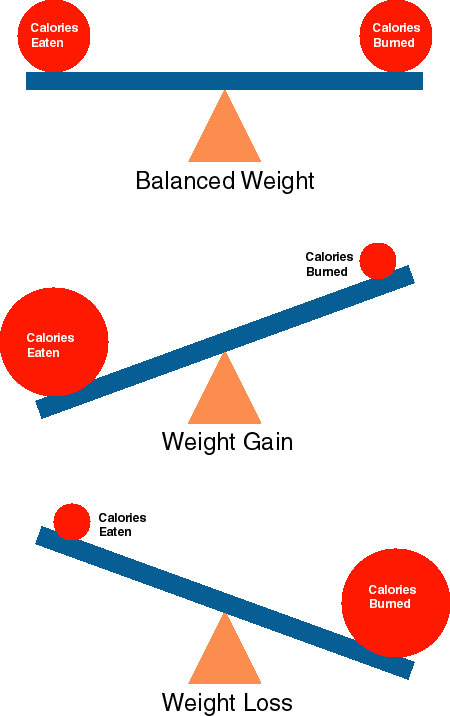
 Losing or gaining weight depends on the balance between the calories you burn and the calories you ingest during the day. If the calories you ingest are less than the calories you burn, you will lose weight because the system will turn to its stored energy reserves (which include stored fat) to get the energy it needs. If the input calories are more than the output calories, you will gain weight because the excess calories will usually be stored as fat. If input and output are about the same, your weight will be stable. Thinking only in terms of weight loss (and not health or performance), it doesn’t matter if the calories being burned are coming from carbs, proteins, or fats. A calorie is a calorie. That’s almost all you really need to know.
Almost but not quite. There’s one important modifying factor to consider that we’ll look at in more detail in the next two posts in this series. In order to take this modifying factor into account when you’re riding your bike, you need to try to get better every time you ride. Every time out try to get a little stronger, go a little faster, ride a little longer. That’s really all you need to do.
Riding like this will result in weight loss for the simple reason that in most cases when you add the calories you burn during the ride to the calories you burn during the rest of the day the total calories burned is greater than the calories you take in by eating. If you burn more calories than you take in, you will lose weight. Simple. And you don’t need to support the diet industry with your hard-earned cash to do it.
People who take the first approach try maximize weight loss by obsessing over how many calories, what kind of calories, when you eat those calories, and all the rest of it. People who take the second approach try to maximize the enjoyment they get from riding the bike. They work on spending more time on the bike doing the things they enjoy about riding the bike. When you engage in exercise or athletic activity you’ll burn the calories whether you enjoy what you’re doing or hate it, whether you’re thinking about losing weight or thinking about whatever you think about when you’re having fun. So, why not give your attention to enjoying yourself and having fun rather than on how much you’ll weigh the next time you get on the scale?
 When you focus on riding the bike because you enjoy it rather than riding the bike as a weight loss procedure all of the questions about calories and weight loss turn into questions about how to be a better rider. Getting better on the bike usually means increasing your strength and endurance so you can ride harder, longer or faster. Eating isn’t about minimizing calories anymore, it’s about supporting performance. As your performance increases and you ride harder, longer or faster, you burn more calories whether you’re trying to lose weight or trying to be a better cyclist. If you ride hard enough and often enough, you can eat whatever you want because no matter how many calories there are in what you eat, you’ll burn more on the bike and lose weight.
If you don’t really enjoy riding the bike, find another type of exercise that you do enjoy. If you enjoy something, you’ll want to do it; if you want to do it, you’ll find a way to do it; if you do it, you’ll burn the calories and lose the weight. Find something energetic that you enjoy, do it frequently and consistently and always try to get better at it and the weight will come off. It won’t happen overnight, it won’t happen fast, you’ll hit plateaus, but if you keep striving to ride harder, faster, stronger, longer, you will lose weight.
Once you’ve started to lose weight there’s another factor you have to consider which we take a look at in the next post in this series.






 Tuned In To Cycling