Cycling Nutrition: The Value of the Glycemic Index for Cyclists

idiots guide

Information about the glycemic index and many other topics can be found in Nutrition for Cyclists: Eating and Drinking Before, During and After the Ride which can be purchased on Amazon.com.  For information about the book and how it relates to what I’ve posted to Tuned In To Cycling, please check out this post.

The diet industry is big business; in the US it is estimated that people spend in the neighborhood of $35 billion dollars a year on diet-related products.  (To make that number more comprehensible, if you make $50,000 a year Americans spend your yearly salary on diet products approximately every 80 seconds.  24, 7, 365.)  A large part of this industry relies on consumer ignorance and gullibility to enable the promotion and sale of one fad diet idea after another.  One of the ideas heavily promoted in the diet industry is the glycemic index.

Is the glycemic index useful? Yes.  Is it all the diet industry makes it out to be?  Not even close.  For our purposes here, is it useful to cyclists?  I think the best answer here is – marginally.

First of all, what is it?  The glycemic index is an indicator of how long it takes food to be converted to glucose in the blood.  Glucose is the fuel that muscles burn when they are working and on-the-bike cycling nutrition and performance is largely about glucose production and consumption.  Having an idea of how long it will take to get the food you eat while you ride converted into blood glucose has the potential to be very useful.

Will the glycemic index tell you how long it takes for the Powerbar or raisins you ate to be converted to blood glucose in seconds, minutes and hours?  No.  The glycemic index compares the time it takes for a particular food to be converted to glucose in the blood to the time it takes for pure glucose ingested orally to appear as glucose in the blood.  Glucose is arbitrarily assigned a glycemic index value of 100 to serve as a basis for comparison.  Particular foods are then given a glycemic index value, typically less than 100, based on how long they take to be converted to blood glucose in comparison to pure glucose.  A high glycemic index indicates a food is rapidly converted to blood glucose; a low glycemic index value means it takes a relatively longer time for that food to be converted to blood glucose.  The glycemic index doesn’t tell you how long it takes to get blood glucose out of food, it gives you a rough idea which foods are converted to blood glucose more quickly than others.
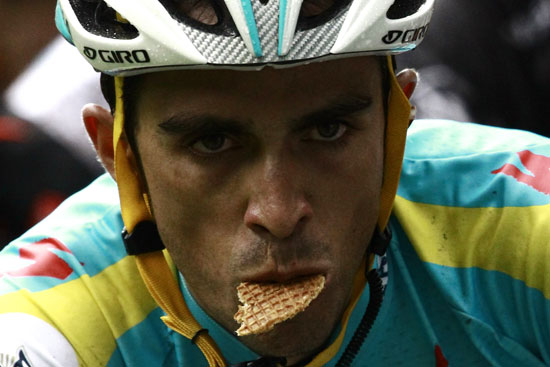
eating on bikeThis sounds like it should be of great use to the cyclist.  You’re burning glucose constantly on the bike, you need more, you’re eating to get more, the glycemic index will tell you what to eat to get that glucose as quickly as possible.

It’s all good, right? Not really. Why not?

The glycemic index of most food varies with so many factors that the rough idea the glycemic index gives you of which foods are converted into blood glucose faster can be very rough indeed.  Here are some examples.

  1. For many foods, glycemic index varies as a function of how the food was prepared (pasta boiled for 10 minutes has a different glycemic index than pasta boiled for 15 minutes), when it is eaten relative to when it was cooked (potatoes often have a higher glycemic index when eaten after cooking than they do if refrigerated  and then reheated and eaten the next day), how ripe the food is when eaten (generally, the glycemic index of fruit increases as the fruit ripens), or which variant of the food type you are eating (different types of raisins have different glycemic indices).
  2. Glycemic index for a particular food varies depending on what is eaten along with that food.  Fat, protein or fiber eaten along with a particular food usually results in a lower overall glycemic index.  For example, you’ll usually get faster blood glucose from raisins eaten alone than the raisins in a cookie.
  3. Different people will have a different glycemic index for the same food because individuals differ in how efficiently they digest carbohydrates.  In addition, the same person may have a different glycemic index for the same food when that food is eaten at different times of the day.
rough categories

The glycemic index values that are used to define the categories in this image are rough guides.

Considering all of these factors, I think the glycemic index can be modestly useful to the cyclist planning what to eat during a ride.  There are many glycemic index charts for different foods that can be found on the internet.  The specific numbers given in these charts are best thought of as rough estimates.  For the cyclist it’s probably most useful to consider glycemic index in terms of three rough categories: High, medium and low glycemic index foods.  High glycemic index foods will probably provide needed glucose throughout the ride.  On long rides of two hours or more, low glycemic index foods can produce needed glucose later in the ride if the food is eaten early in the ride.  As you get closer to the end of the ride, higher glycemic index foods are more likely to be beneficial while you’re still on the bike.

WARNING:  The nutritional needs of a person engaged in 60 to 90 minutes of moderate to intense exercise or a long ride lasting more than 2 hours are very different from the nutritional needs of that same person going about their daily activities.  High glycemic foods can be very useful while you’re on the bike.  A steady diet of high glycemic foods when you’re not engaged in endurance exercise has been shown to be related to various health problems such as obesity (and all of its related problems), diabetes and, at least in animal studies, a shortened life span.  High glycemic foods eaten while you’re riding will generally help you.  A day-in, day-out diet of high glycemic foods when you’re not exercising will generally hurt you.
Dehydration and Over Hydration (Hyponatremia) for the Cyclist

More information about dehydration and how to avoid it can be found in Nutrition for Cyclists: Eating and Drinking Before, During and After the Ride which can be purchased on Amazon.com.  For information about the book and how it relates to what I’ve posted to Tuned In To Cycling, please check out this post.

There’s a lot of water around us; roughly 70% of the earth’s surface is covered in water. There’s also a lot of water in us; roughly 60% of the human body is water. The balance between the water inside and outside our bodies has to be kept within a fairly narrow range or bad things can happen. Either too much or too little water inside the body can, in extreme cases, be lethal.

When you ride your bike your body loses water in the form of sweat. This is a good thing because the evaporation of sweat from the skin is the main way your body sheds heat while you’re on the bike. Without that cooling the increase in body core temperature from the heat generated by your working muscles would kill you fairly rapidly.

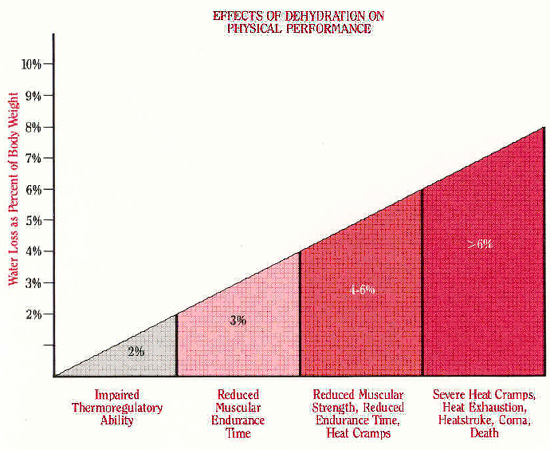
Sweating is good but the fluid loss that comes from sweating is not so good. When you lose water through sweat you become dehydrated. At extreme levels dehydration can lead to heat stroke which can be life threatening. However, even relatively mild levels dehydration can have negative effects on cycling performance.

How dehydration affects your body

For the endurance cyclist the main effect of dehydration is to decrease the volume of blood in the system. This has two major consequences and both of them are bad.

First, a decrease in blood volume reduces the body’s ability to shed heat and thus leads to an increase in core temperature. This works in two ways. The main way the body sheds heat during exercise is through sweating. When blood volume is decreased through dehydration sweating decreases because the water in sweat is derived from blood plasma. You can’t sweat it out if it’s not there in the first place.

In addition to sweating, the body sheds excess heat by radiation and conduction if the air temperature is lower than the body temperature. When body temperature rises the blood vessels near the surface of the skin expand (vasodilation). This brings more of the blood into close contact with the surface of the body so that heat carried by the blood can be lost through conduction and radiation. A decrease in blood volume decreases the amount of blood that can be brought into contact with the body’s surface thereby partially offsetting the benefits of vasodilation.

The second negative effect of the decrease in blood volume caused by dehydration is that the blood becomes thicker or more viscous. The heart has to work harder to pump the thicker fluid through the body. Blood flow becomes more sluggish. During diastole (the resting phase when the heart fills with blood) the heart may not completely fill with blood so that the volume of blood pumped with each heartbeat declines. Blood flow throughout the body declines and blood flow to the working muscles is critical for the cyclist because it brings fuel to the muscle in the form of glucose, and carries away waste materials and heat.

How dehydration affects performance

Dehydration and increase in body temperature are separate factors that have independent effects on athletic performance. They also interact with each other to decrease performance. It’s helpful to keep in mind how both of these factors are affecting performance both individually and in combination.

A loss of as little as 2% body weight (3 lbs. for a 150 lb. person) can negatively affect athletic performance. This negative effect increases as the amount of time spent performing the exercise increases. A study carried out with runners showed that a roughly 2% loss in body weight due to dehydration produced approximately a 3% loss in performance over 1500 meters and a 5% loss in performance over 5K or 10K meters. A loss of 5% body weight through dehydration (7.5 lbs. for a 150 lb. person) has been shown to produce approximately a 30% loss in performance.

VO2 max is a measure of the maximum amount of oxygen a person can use during exercise and is widely used as a general measure of aerobic fitness. Studies carried out in cool laboratory environments have shown a 5% decrease in VO2 max with a 3% decline in body weight through dehydration. The negative effect of dehydration on VO2 max is increased in the warm or hot environments the cyclist usually experiences. Decreases in VO2 max are most probably caused by the decrease in blood volume produced by dehydration that was discussed earlier. Note also that increased body temperature can reduce VO2 max even when individuals are fully hydrated. In other words, dehydration and increased body temperature act alone and in combination to decrease VO2 max.

Whether or not it is accompanied by a decrease in VO2 max, dehydration produces a decline in endurance as measured by the time it takes to reach exhaustion. A loss of 5% body weight through dehydration can decrease endurance even for low intensity exercise (e.g., low intensity walking). The loss in endurance increases markedly as either the intensity of exercise increases or the level of dehydration increases.

Endurance is also affected by core temperature; as core temperature increases, endurance decreases. Because dehydration has a large effect on the body’s ability to shed heat, core temperature rises more quickly and endurance decreases more quickly as dehydration increases. In addition, dehydration produces a lower tolerance for increased core temperatures. Exhaustion occurs at lower core temperatures for dehydrated individuals as opposed to hydrated individuals.

As if all that isn’t enough, there is evidence that suggests that dehydration in combination with increased core temperature my cause glucose to be burned more quickly and less efficiently in working muscles. Glucose is the fuel that powers muscle activity, it’s almost always in short supply for the endurance cyclist, and the evidence suggests it’s used less efficiently when dehydration is accompanied by increased core temperature (which it almost always is). You’re trying hard to keep going and avoid the bonk by paying attention to what you eat while you’re riding, you are always short on fuel, and dehydration is causing you to burn the limited fuel you have available less efficiently. Not good.

Stay hydrated.

Over hydration or hyponatremia

Is it possible to drink too much water? Yes, the condition is called hyponatremia and in rare cases it can be fatal. When the body is over saturated with water the sodium in the body becomes diluted. When this happens individual cells throughout the body swell with the result that a variety of bodily functions may be disrupted.

At present we don’t know as much about athletically induced hyponatremia as we would like. The condition was first described in 1981 and much of the data that exists about hyponatremia is drawn from samples of convenience taken at popular athletic events such as marathons and reports from the military documenting the consequences of water consumption during training. The problem with samples of convenience is that important variables are left uncontrolled that need to be controlled in order to draw sound and justified conclusions from the data.

Hyponatremia is diagnosed based on the level of sodium in the blood and measuring serum sodium level is relatively easy. The problem is that the serum sodium level that is widely accepted as indicating hyponatremia may be accompanied by a variety of symptoms ranging from confusion or seizures, through headaches and stomach distress, to, in many cases, no symptoms at all.

Hyponatremia began to be commonly observed along with the rise of marathon running as a popular hobbyist sport. In order to prevent dehydration and heat stroke race organizers frequently stress the importance of staying hydrated during the run and they provide frequent water stations along the route. In addition, manufacturers of “sport drinks” often market their products at open running events and pay the organizers to make their drink available to runners along the route.

Under these circumstances you might expect relatively inexperienced hobbyist runners to drink too much during their run. There appears to be evidence that this is the case. Hyponatremia has been observed to be much more common among inexperienced runners who train at slower speeds and take more time to complete the marathon.

At present, it is unclear whether women are more susceptible to hyponatremia than men. Some studies suggest they are, other, better controlled studies, suggest there’s no difference. Also, there is no evidence that the sodium content of many “sports drinks” serves to prevent hyponatremia .

How can you tell if you’re drinking too much water when you ride? A rough method is to weigh yourself right before and right after your ride. If you gained weight and drank a lot of fluids during the ride, you were probably over hydrating.

In the absence of medical complications, avoiding hyponatremia is basically a matter of common sense. Anecdotal reports in the medical literature about people who experienced extreme hyponatremia include very slow runners who took very long times to finish marathons and who reported drinking at every water station along the way and a woman who prepared for her marathon by drinking 10 liters of water (!!) the night before. Use your head for something besides a place to keep your helmet while you ride and don’t drink excessive amounts of fluids and you shouldn’t have a problem. Most important, don’t become dehydrated because you’re afraid of hyponatremia.