Cycling in Heat and Humidity

More information about hydration can be found in Nutrition for Cyclists: Eating and Drinking Before, During and After the Ride which can be purchased on Amazon.com.  For information about the book and how it relates to what I’ve posted to Tuned In To Cycling, please check out this post.

It’s hot. It’s humid. Even worse, it’s hot and humid. How do you handle heat and humidity on a ride? You already know the answer. Hydrate. Is there anything else you can do? Yes, but hydration is far and away the most important thing you need to combat heat and humidity. Understanding how heat and humidity affects you when you’re riding (or engaging in any other kind of exercise) can help you counter their ill effects.

How the body keeps cool

“Normal” body temperature is a slippery concept because many factors such as the time of the day, how temperature is measured, your state of athletic training, and where you are in your menstrual cycle if you are a woman (among other things) affects body temperature. For most cycling purposes, exact measures of normal body temperature along with exact measures of safe increases in body temperature aren’t very useful. You’re not going to know what your body temperature is while you’re riding because you’re not going to be taking rectal temperature measurements while you’re on the bike. Also, it doesn’t really matter what constitutes a “safe” increase in body temperature because you are going to be stressing your body’s ability to maintain that safe level when you ride.

The human body is a homeostatic system. This means it adapts to changing environmental circumstances in order to maintain certain physical and physiological parameters within acceptable boundaries. One of the most important of these parameters is core temperature. Combating heat and humidity is mainly about keeping core temperature down.

Our bicycles are extraordinarily efficient machines. Under optimal circumstances approximately 99% of the energy put into the pedals is transferred into forward motion; only 1% is lost. Unfortunately, our bodies are not nearly as efficient. Approximately 75% of the energy generated by physical activity is lost as heat. The heat generated by our muscles raises body temperature when we exercise. The harder you go, the more heat you make and the more stress you place on your body to shed that heat and keep core temp down.

There are two main ways the human body sheds heat. When the temperature of the body is higher than the temperature of the surrounding environment heat is shed through conduction and radiation. Here’s how this works for the cyclist. Your working muscles generate a lot of heat. Much of this heat is transferred to the blood which carries it away from the working muscles. When blood temperature reaches a particular threshold, vasodilation (expansion of the blood vessels at the surface of the body) occurs which brings a larger proportion of the blood into close contact with the surface of the body where it can shed its heat to the surrounding environment. When you stand close to a person who has been exercising hard you can feel the heat coming off their body. That’s heat that has been shed through conduction and radiation.

Conduction and radiation can only reduce body heat if the surrounding environment is at a lower temperature than the body. If air temperature is higher than body temperature, the body takes on heat from the environment. If you are riding on a hot day, conduction and radiation aren’t going to be nearly sufficient to shed the heat you’re generating.

The second way the body sheds heat is through evaporative cooling. When core temp rises to a critical threshold, the sweat glands are triggered and sweat is produced on the surface of the skin. The sweat evaporates and the evaporation cools the body. Under most circumstances, and especially when it is hot outside, evaporative cooling is the main way the cyclist sheds heat.

How increased core temp can hurt you

When you exercise your core temp rises. When core temp rises you sweat. When you sweat you lose fluid. If you lose enough fluid you become dehydrated. Dehydration and overhydration are important issues for the cyclist that are taken up in the post Dehydration and Over Hydration (Hyponatremia) for the Cyclist.

Even low levels of dehydration can affect performance. Loss of 2% body weight through fluid loss has measurable negative effects on athletic performance. Holding fluid loss constant, the negative effects increase the longer you ride or the hotter it is when you ride. As fluid loss increases beyond 2% body weight., the negative effects of dehydration increases rapidly and markedly.  This is the good news.

The bad news is that loss of body fluids can produce severe dehydration and heatstroke. The symptoms include headache, nausea and vomiting, sweating stops or is severely reduced, very rapid breathing and heart rate, confusion, delirium, loss of consciousness, death. Heatstroke is a life threatening medical emergency. In a lifetime of athletic activity that has produced broken bones, snapped tendons, knocked out teeth, severe lacerations and several surgeries, the one time I suffered serious heatstroke (while running in competition) was – easily, hands down, no contest, and by far – the worst physical experience of my athletic life. You don’t want to go there, it’s terrible.

How all of this affects the cyclist
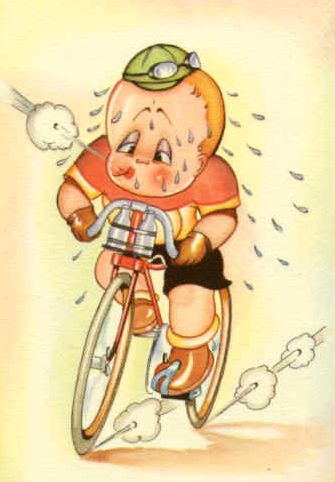
Heat is bad. As the air temperature rises, the difference between body and air temperature decreases which weakens or eliminates conduction and radiation as methods of shedding heat.

Humidity is worse. Evaporative cooling is the primary way humans shed heat and it becomes even more important when exercise is producing a lot of excess heat. Humidity is an index of the amount of water vapor in the air; the higher the humidity, the more the air is saturated with water. The more the air is saturated with water, the less water it can take on which means that sweat is less likely to evaporate. The body continues to produce sweat so that evaporative cooling can bring body temperature down, but the sweat rolls off the skin rather than evaporating and cooling the body.

The air flow produced by moving on the bike can be a help here. When you stand still and sweat the air around you becomes saturated and sweating produces less evaporative cooling. When you’re rolling on the bike, the air around you is constantly being refreshed with air that is less saturated.

Heat combined with humidity is the worst of all. High heat coupled with high humidity sabotages both of the body’s mechanisms for shedding heat. The high air temperature reduces or eliminates conduction and radiation and the high humidity reduces evaporative cooling.

What can you do about it?

First and foremost – HYDRATE. Drinking water won’t cool you directly but it will replace the fluid you’re losing to sweat. This is critical for avoiding dehydration and heatstroke. Don’t screw around with this. Heatstroke can kill you.

How much should you drink? It depends on how much fluid you are losing to sweat and this will vary as a function of many factors such as how hot it is and how hard you’re working. Don’t use feeling thirsty as an indicator of whether or not you need to drink. The body is relatively slow to send thirst and hunger signals. You will usually have lost 1% to 2% of your body weight in fluid loss before you get the thirsty signal. By that time you’re already losing the battle of shedding excess body heat. A common mantra for cyclists is “Drink before you’re thirsty.” It’s great advice. Drink small amounts often rather than large amounts less frequently.

It’s possible to overhydrate which can lead to a condition called hyponatremia where there are abnormally low levels of sodium in the body (the excess water dilutes the sodium). This can also be life threatening although it rarely is. When hydrating your goal is to continually replace the fluid you lose through sweating without going to extremes with either too much water or not enough. For the cyclist riding in heat and humidity it’s better to err on the side of limiting dehydration as opposed to limiting hyponatremia. Don’t prepare for riding by drinking liters of water beforehand and be sensible on the bike. A future post will look at hyponatremia in more detail.

Wear the right clothing. No clothing at all would be optimal but sunburn, chafing from the bicycle seat and indecency laws make that impractical.  If you’re not going to go nude, you want form fitting clothing that wicks moisture. Loose clothing traps air between the cloth and your skin which acts as insulation and reduces evaporative cooling. Wicking material moves the sweat from your skin to the air where it can evaporate and cool you. Cycling clothing has both of these properties so if you wear tight fitting cycling shorts and jerseys, you’re good. If you ride in a loose fitting cotton shirt, you’re asking for trouble when it’s hot and humid.

If you’re not racing, consider ramping down your work level on hot and humid days. If you ride at a slower pace, your leg muscles aren’t working as hard and are producing less excess heat.

If you have enough water, pour it on yourself. Evaporating sweat and water both produce evaporative cooling. Remember, though, that the water will do more to help you when it’s inside your body than when it’s on the outside. Don’t become dehydrated because you poured your water over your head.

Human Growth Hormone and Cycling

This post is mainly oriented toward the cyclist who is concerned with taking Human growth hormone (HGH) or so-called “HGH releasers” orally as a dietary supplement.  Intravenous injection of HGH  is a much more serious and much more expensive proposition and deserves a more detailed analysis than the one that will be given here.

HGH has been offered as something like a universal miracle drug for everything from building muscle mass and recovery from exercise to enhancing virility, curing depression and combating the effects of aging.  One of the ideas that is promoted by the HGH industry is that there is a two hour period after exercise, which is sometimes referred to as a “synergy window”, when consumption of  foods that are high in glucose or carbohydrates disrupts the release of HGH by the body and hence should be avoided because of all of the benefits claimed for HGH. A comment on our Eating After the Ride post  pointed out that the advice to consume a fairly large amount of carbohydrate in the first 30 to 40 minutes after exercise that is given in Eating After the Ride is in direct conflict with the recommendation to avoid carbohydrates during the Synergy Window.

Is this an important conflict that cyclists should take into account?  What can be said about the “synergy window” based on reputable research?  Are the claims made about the benefits of HGH accurate and reliable?  Should cyclists be concerned with HGH?

It is important to keep in mind that – like virtually every issue in the field of nutrition for athletes – knowledge about HGH that is based on well-designed and carefully carried out scientific research is a story in progress.  Much remains to be discovered about how chemical information carriers (i.e, hormones and neurotransmitters) affect function, how the human body processes nutrients and macronutrients (like carbs, fats and proteins), and how all of this affects exercise and athletic performance.

That being said, the HGH industry is a cesspool of outright fraud, ignorance, scams and ridiculous claims based on no scientific evidence whatsoever.  The problem isn’t that scientifically well-supported information about HGH is hard to come by; 20 minutes, google, and an open mind are about all it takes to at least raise the suspicion that many of the claims made about HGH on numerous websites and blogs are complete nonsense.  The problem is that too many people are making too much money selling quack nostrums to gullible people who are ignorant of the science involved and who aren’t willing to spend the time or effort to look beyond what the hucksters are pitching at them.

What about the concern that ingesting carbohydrates will interfere with the two hour HGH “synergy window”?

If, at the time of this writing, you google “synergy window” and “HGH”, you get several pages of hits from many, many websites and blogs that all reproduce the same text.  Many of these pages are headed “Two foods you should never eat after exercise”.  The text copied on all of these websites and blogs claims, among some other things, that sugars (i.e., carbohydrates) must be avoided during the two hour synergy window in order to reap the supposed benefits of increased  HGH production after exercise. This advice is accompanied by a citation to a well-designed and well-executed research study and gives the impression that the research study supports the claims being made about HGH, the “synergy window” and avoiding carbohydrates in the form of sugars after exercise.

The research cited in the “synergy window” blurb was carried out by S.A. Newsom and colleagues and appeared in the March 2010 Journal of Applied Physiology.  You can read it for yourself here.  The study contains research that may be of interest to cyclists and is described in detail in Eating After the Ride Part 2.

Our question here is how much support does the cited research give to the claims being made about HGH, the “synergy window” and avoiding carbohydrates after exercise?

The answer is – none whatsoever.

The Newsom study has nothing at all to do with HGH.  The investigators are interested in the consequences of replacing calories lost during exercise by ingesting either fats or carbohydrates after exercise.  They don’t consider, or even mention, HGH.

What about a two hour window after exercise?  In the study, participants ate meals with carefully controlled amounts of fats and carbohydrates 30 minutes, 5 hours and 10 hours after exercise.  Nothing was manipulated nor measured at a two hour interval.  Nothing can be concluded from this study about the consequences of eating or not eating carbs, fats, proteins or anything else during the two hours after exercise because the study doesn’t have anything to do with a two hour post exercise period.

In short, while the Newsom research contains much of interest to people who are engaged in regular exercise, it provides no support whatsoever for the claims about HGH, the so-called “synergy window”, or the advice to avoid carbs after exercise that appear on all of the websites and blogs that cite the research. The people who are posting this “synergy window” nonsense all over the internet either didn’t read the research paper they cite, read it and didn’t understand it, or read it, understood it and are making fraudulent claims based on it with the expectation that their readers won’t bother to check their source.

The websites telling you not to consume carbs after exercise because it will interfere with HGH have nothing  to offer in the way of scientific evidence to support their stories.  Does HGH provide some other benefits for cyclists? Or any other basically healthy person for that matter?

The first thing to keep in mind is that for HGH to have any effect at all, it must be taken intravenously. HGH is a peptide and peptides are broken down by gastric acid in the digestive tract which means that taking HGH orally is pointless.  It is most likely to be destroyed before it enters the bloodstream.  This is fairly elementary biochemistry and you would expect people who are recommending and selling dietary supplements to know it.  The HGH mongers apparently didn’t, however, and at first they were hawking HGH as a dietary supplement.  Now they are hawking “HGH releasers” which aren’t HGH but are supposed to trigger the release of HGH by the body.  What they are in fact selling are branched-chain amino acids which account for approximately 35% of the amino acids found in muscle proteins.  You can get a roughly equivalent amount of branched chain amino acids as are present in high-priced “HGH releasers” by eating a piece of steak.  There is no credible evidence that these so called “HGH releasers” have any of the beneficial effects claimed for them.  If you are taking HGH or an “HGH releaser” orally as a dietary suplement, you are throwing your money away on a scam.

When pressed for evidence by fraud litigation or by consumers who want evidence rather than unsubstantiated advertising claims before they take dietary supplements, the HGH industry has consistently pointed to a study published by D. Rudman and colleagues entitled “Effects of Human Growth Hormone in Men over 60 Years Old” in the New England Journal of Medicine (NEJM) in 1990.  You can read the Rudman study for yourself here.

What Rudman et. al found was that a six month program of  high-dose intravenous injections of HGH reduced the percentage of body fat and increased the percentage of lean muscle mass and bone density in a group of men aged 61 to 81. This study has been so widely misunderstood, misinterpreted or used in support of outright fraudulent claims about HGH that the editors of the New England Journal of Medicine took the highly unusual step of attaching editorials written by Dr. Mary Lee Vance (who was the editor of NEJM when the Rudman study was originally published) and Dr. Jeffrey M. Drazen (who was the editor when the decision to add the attachments was made) that pointed out that the research reported in the Rudman article does not providence evidence to support the claims about the benefits of HGH or “HGH releasers”  made by the people in the HGH industry who cite the study as scientific support for their products.  You can read Dr. Vance’s editorial here, and Dr. Drazen’s editorial here.

Subsequent research published in the Journal of the American Medical Association (an Abstract can be found here) that has followed up on the Rudman study and which is cited in the Vance editorial has replicated Rudman’s results with regard to HGH producing a decrease in body fat and an increase in lean muscle mass.  While the Rudman study did not examine differences in muscle function as a consequence of HGH treatment the follow up study did and what was found is of great interest to cyclists who are considering taking HGH.  The increase in lean muscle mass was not accompanied by any increase in either strength or endurance (as measured by maximal oxygen uptake, i.e., VO(2)max) in women.  Strength increased slightly and VO(2)max increased in men but only if the HGH treatment was accompanied by testosterone injections.   HGH without testosterone produced increases in lean muscle mass but no increases in either strength or endurance.  Negative side effects, primarily diabetes and glucose intolerance, were frequent in both men and women who were administered HGH.

These results may sound encouraging for some body builders for whom the increase in muscle mass combined with a decrease in body fat (which makes the musculature easier to see) may contribute to the goal of displaying muscle development.  Body builders are essentially developing muscles to serve as decoration or ornament.  Their competition does not involve using muscle strength in any way and so the lack of increase in strength or endurance accompanied by the increase in muscle mass that is produced by HGH alone would not hurt them when they compete.  For athletes who are interesting in building stronger muscles as opposed to bigger muscles the story is entirely different.  For the cyclist, increased muscle mass that is not accompanied by an increase in strength or endurance is simply dead weight that has to be carried uphill.

So, what’s the story on HGH for cyclists?

HGH or “HGH releasers” taken as orally administered dietary supplements are scams.  There is no credible scientific evidence that these products have any of the benefits that are claimed for them.

Intravenous injection of HGH increases lean muscle mass without an increase in either endurance or strength.  It adds weight without improving function which is something every cyclist wants to avoid.

HGH injections that are accompanied by testosterone injections increase endurance and marginally increase strength in men.  While the increase in VO(2)max may be of value to competitive cyclists, the HGH injections have serious negative consequences such as the development of diabetes and glucose intolerance (which will more than offset the competitive benefits gained through HGH use).  HGH is also banned as a performance enhancing drug.  Patrick Sinkewitz tested positive for HGH and was the first rider banned from the pro peloton for HGH use.

For professional cyclists there is a temptation to inject HGH and hope to avoid a positive drug test.  For the non-professional cyclist there is no reason whatsoever to take HGH and many reasons to avoid it.

For cyclists, HGH is an epic fail