Unknown's avatar

About Kevin Murnane

I am a cognitive scientist, a freelance writer and author (Nutrition for Cyclists: Eating and Drinking Before, During and After the Ride), a musician (Parametric Monkey - stream on Spotify, Soundcloud and YouTube), a bookstore owner (Monkey Books - first edition mystery, science fiction, fantasy and more, listed on ABE books, Amazon and Biblio), and a retired house painter, children's theater actor & owner, and university professor. I'm also a regular contributor to the technology section at Forbes and I write a cycling blog called Tuned In To Cycling. You can follow me on twitter @TheInfoMonkey and contact me at murnane.kevin@gmail.com.

Cycling Nutrition: The Value of the Glycemic Index for Cyclists

idiots guide

Information about the glycemic index and many other topics can be found in Nutrition for Cyclists: Eating and Drinking Before, During and After the Ride which can be purchased on Amazon.com.  For information about the book and how it relates to what I’ve posted to Tuned In To Cycling, please check out this post.

The diet industry is big business; in the US it is estimated that people spend in the neighborhood of $35 billion dollars a year on diet-related products.  (To make that number more comprehensible, if you make $50,000 a year Americans spend your yearly salary on diet products approximately every 80 seconds.  24, 7, 365.)  A large part of this industry relies on consumer ignorance and gullibility to enable the promotion and sale of one fad diet idea after another.  One of the ideas heavily promoted in the diet industry is the glycemic index.

Is the glycemic index useful? Yes.  Is it all the diet industry makes it out to be?  Not even close.  For our purposes here, is it useful to cyclists?  I think the best answer here is – marginally.

First of all, what is it?  The glycemic index is an indicator of how long it takes food to be converted to glucose in the blood.  Glucose is the fuel that muscles burn when they are working and on-the-bike cycling nutrition and performance is largely about glucose production and consumption.  Having an idea of how long it will take to get the food you eat while you ride converted into blood glucose has the potential to be very useful.

Will the glycemic index tell you how long it takes for the Powerbar or raisins you ate to be converted to blood glucose in seconds, minutes and hours?  No.  The glycemic index compares the time it takes for a particular food to be converted to glucose in the blood to the time it takes for pure glucose ingested orally to appear as glucose in the blood.  Glucose is arbitrarily assigned a glycemic index value of 100 to serve as a basis for comparison.  Particular foods are then given a glycemic index value, typically less than 100, based on how long they take to be converted to blood glucose in comparison to pure glucose.  A high glycemic index indicates a food is rapidly converted to blood glucose; a low glycemic index value means it takes a relatively longer time for that food to be converted to blood glucose.  The glycemic index doesn’t tell you how long it takes to get blood glucose out of food, it gives you a rough idea which foods are converted to blood glucose more quickly than others.
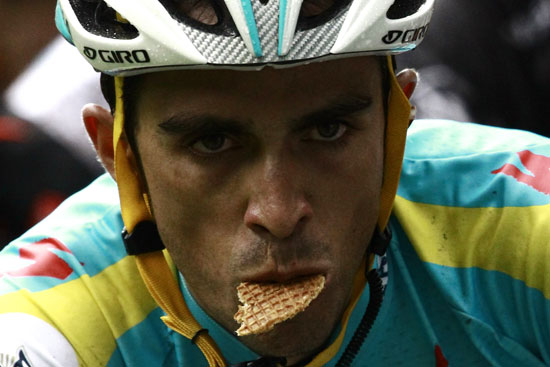
eating on bikeThis sounds like it should be of great use to the cyclist.  You’re burning glucose constantly on the bike, you need more, you’re eating to get more, the glycemic index will tell you what to eat to get that glucose as quickly as possible.

It’s all good, right? Not really. Why not?

The glycemic index of most food varies with so many factors that the rough idea the glycemic index gives you of which foods are converted into blood glucose faster can be very rough indeed.  Here are some examples.

  1. For many foods, glycemic index varies as a function of how the food was prepared (pasta boiled for 10 minutes has a different glycemic index than pasta boiled for 15 minutes), when it is eaten relative to when it was cooked (potatoes often have a higher glycemic index when eaten after cooking than they do if refrigerated  and then reheated and eaten the next day), how ripe the food is when eaten (generally, the glycemic index of fruit increases as the fruit ripens), or which variant of the food type you are eating (different types of raisins have different glycemic indices).
  2. Glycemic index for a particular food varies depending on what is eaten along with that food.  Fat, protein or fiber eaten along with a particular food usually results in a lower overall glycemic index.  For example, you’ll usually get faster blood glucose from raisins eaten alone than the raisins in a cookie.
  3. Different people will have a different glycemic index for the same food because individuals differ in how efficiently they digest carbohydrates.  In addition, the same person may have a different glycemic index for the same food when that food is eaten at different times of the day.
rough categories

The glycemic index values that are used to define the categories in this image are rough guides.

Considering all of these factors, I think the glycemic index can be modestly useful to the cyclist planning what to eat during a ride.  There are many glycemic index charts for different foods that can be found on the internet.  The specific numbers given in these charts are best thought of as rough estimates.  For the cyclist it’s probably most useful to consider glycemic index in terms of three rough categories: High, medium and low glycemic index foods.  High glycemic index foods will probably provide needed glucose throughout the ride.  On long rides of two hours or more, low glycemic index foods can produce needed glucose later in the ride if the food is eaten early in the ride.  As you get closer to the end of the ride, higher glycemic index foods are more likely to be beneficial while you’re still on the bike.

WARNING:  The nutritional needs of a person engaged in 60 to 90 minutes of moderate to intense exercise or a long ride lasting more than 2 hours are very different from the nutritional needs of that same person going about their daily activities.  High glycemic foods can be very useful while you’re on the bike.  A steady diet of high glycemic foods when you’re not engaged in endurance exercise has been shown to be related to various health problems such as obesity (and all of its related problems), diabetes and, at least in animal studies, a shortened life span.  High glycemic foods eaten while you’re riding will generally help you.  A day-in, day-out diet of high glycemic foods when you’re not exercising will generally hurt you.

Gearing Part 1: The Basics

GearsThis is the first of several posts on gearing for road bikes.  It’s aimed at riders who are seeking a basic understanding of bicycle gearing.  All of the numbers used in this post are either approximate or chosen to make the arithmetic (which is simple) easy to follow.

There are several ways to talk about gearing, some useful, some not so much.  I once had a cycling computer that gave gearing information by assigning numbers (1, 2, 3, 4, etc.) to each of the rings and each of the sprockets on the cassette.  It would tell me I was in the 3-8 gear or the 2-2 gear, for example.  This is not a good way to think about gearing.  Rings and cassettes come in many different sizes and configurations and the 5 sprocket on one cassette may be different from the 5 sprocket on another.

Experienced riders often talk about gearing in terms of the number of teeth on the ring and on the sprocket on the rear cassette (the gear-tooth method).  They’ll talk about a 52-13 gear (a big gear) or a 42-26 gear (a smaller gear), for example.  The gear-tooth method communicates clearly to riders who are used to thinking about gearing in this way when they ride.  They know exactly what a 52-13 gear is because they have been aware of being in a gear that size while they were riding.

A third way to talk about gearing is in terms of gear-inches.  We’ll come back to this one later.

In order to make the basics of how gears work as easy to understand as possible, I think it’s most helpful to talk about gearing in terms of what is called meters of development.  This is a system that is more commonly used in Europe than in the US.  It defines gears in terms of how far the bike travels every time the pedals complete one revolution.  Someone will say they are in a 4.2 meter gear which means the bike moves forward 4.2 meters (about 13.67 feet) every time the pedals go around once.  This way of talking makes it very clear what is happening as you change gears and makes it easy to talk about gearing for riders who are not used to thinking in terms of gear-tooth pairs.

Take a look at your rear wheel.  The circumference of the rear wheel (including the tire) on an average road bike is roughly 82 inches (6 feet, 10 inches) or about 2.1 meters (rounded to 1 decimal place).  How close it is to 2.1 meters on your bike depends on things like the tire you’re using and how inflated it is.  We’ll use 2.1 meters as a rough guess to make the arithmetic clear.  A 2.1 meter circumference means that you move 2.1 meters (82 inches) forward every time your wheel completes one revolution.

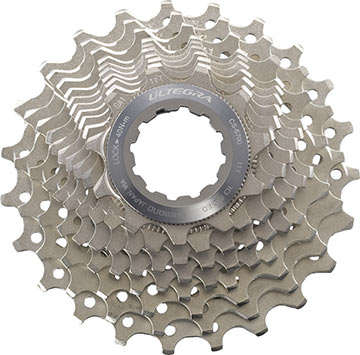
casetteNow take a look at your rear cassette.  It’s fixed to the rear wheel so that every time the wheel goes around once, the cassette goes around once.  But here’s where it gets interesting.  There are different numbers of teeth on each of the sprockets on the rear cassette.  Suppose one of the smaller sprockets has 13 teeth.  If the chain was on that sprocket, it would move through 13 teeth every time the wheel went around once.  A medium to large sprocket might have 26 teeth.  If the chain was on that sprocket, it would move through 26 teeth every time the wheel went around once.

RingsNow take a look at the chainrings attached to your pedals and crank.  Each ring is fixed to the crank so that each time the pedals go around once, the ring goes around once.  A common configuration for a triple-chainring setup has rings that have 52 teeth (the big ring), 42 teeth (the middle ring) and 32 teeth (the small ring).  If you are in the big ring, the chain will move through 52 teeth every time you pedal through one complete revolution.

Combining all of this info about the circumference of the rear wheel and the number of teeth on the rings and sprockets we can see how bicycle gears work.  As you pedal, every time the chain moves through one tooth on the front ring it also moves through one tooth on the sprocket on the rear cassette.  Suppose you are in the big ring that has 52 teeth and your chain is on the sprocket with 26 teeth on the rear cassette.  One pedal revolution moves the chain through 52 teeth on the big ring.  It also moves the chain through 52 teeth on the cassette.  The big ring goes around once but the rear sprocket only has 26 teeth so it has to go around twice (26 X 2 = 52) to take up all 52 teeth.  When the sprocket goes around twice, the rear wheel also goes around twice.  The rear wheel has a circumference of 2.1 meters, it goes around twice, so the bike moves forward 4.2 meters (2.1 X 2 = 4.2).  In this example, a 52-26 gear (speaking in gear-tooth terms; 52 teeth on the ring and 26 teeth on the sprocket) is the same as a 4.2 meter gear (speaking in meters of development terms).

drive trainNow suppose that you stay in the 52 tooth big ring but instead of having the chain in the 26 tooth sprocket on the rear wheel, you change it to the 13 tooth sprocket.  One pedal revolution still goes through 52 teeth on the big ring but now it takes 4 revolutions of the rear sprocket to take up all 52 teeth (13 X 4 = 52).  The rear wheel goes around 4 times instead of two and the bike moves forward 8.4 meters (2.1 X 4 = 8.4) instead of 4.2 meters.  You’re in an 8.4 meter gear.

One way to look at this is that you go twice as far for each pedal revolution in an 8.4 meter gear as in a 4.2 meter gear.  The meters of development way of talking about gearing makes this easy to see because 8.4 is twice as much as 4.2.  Of course, you have to work harder to move the combined weight of you and your bike twice as far but that’s another story.

Notice that what changes when you shift into a harder or an easier gear is the relationship between the number of teeth on the ring and the number of teeth on the sprocket.  Suppose you stay in the big ring and shift up or down on the rear cassette.  The diameter of the rear wheel doesn’t change and neither does the number of teeth on the big ring.  What changes is the number of teeth on the sprocket.

gear ratio chart

Drive ratios (R/S) for a selection of rings (number of teeth listed in the left column) and sprockets (number of teeth listed in the top row)

It’s useful to think about this relationship as a ratio of the number of teeth in the ring to the number of teeth in the sprocket.  This is called the drive ratio.  Let R stand for the number of teeth in the ring and S stand for the number of teeth in the sprocket.  Then the drive ratio can be shown as R/S.    In the case of the 52 tooth ring paired with the 26 tooth sprocket the drive ratio R/S is 52/26 = 2.  The rear wheel goes around twice every time the pedals go around once.  For the 52 tooth ring paired with the 13 tooth sprocket the drive ratio R/S is 52/13 = 4; the rear wheel goes around four times every time the pedals go around once.   In other words, the drive ratio R/S (the number of teeth in the ring to the number of teeth in the sprocket) tells you how many times the rear wheel goes around every time the pedals go around once.

Let C stand for the circumference in meters of the rear wheel.  Remember that gears in the meters of development system are defined in terms of how for the bike goes (in meters) every time the pedals complete one revolution.  This is easily expressed mathematically as Gear = C X R/S.  In English, the gear is equal to the circumference of the rear wheel (C) multiplied by the number of times the rear wheel goes around every time the pedals go around once (R/S).

gear inch imageThe gear-inch method of talking about bike gears that was mentioned earlier is similar to the meters of development method.  They both rely on the very useful drive ratio of the number of teeth in the ring to the number of teeth in the sprocket, R/S.  Rather than use the circumference of the rear wheel measured in meters, the gear-inch method uses the diameter of the rear wheel measured in inches.  Let D represent this diameter.  In the gear-inch method Gear = D X R/S.  Gear inches are more commonly used in the US than meters of development.  As you can see, they are calculated in very similar ways and in both systems bigger numbers equal bigger gears which require more effort.  Meters of development has the advantage of telling you exactly how far you move forward every time you turn the pedals through one revolution.

Here is a table showing how the two gears we used as examples (the 52 tooth ring + 26 tooth sprocket and the 52 tooth ring + 13 tooth sprocket) would be labeled in the gear-tooth, gear-inch and meters of development methods.  The gear-inch method was calculated assuming a 27 inch diameter rear wheel.

Method Gear 1 Gear 2
Gear tooth 52 – 26 52 – 13
Gear inch 54 inch 108 inch
Meters of development 4.2 meter 8.4 meter