Cycling Nutrition: The Basics – Glucose, Glycogen and Carbohydrates

More information about the basics of fueling the muscles and hydration can be found in Nutrition for Cyclists: Eating and Drinking Before, During and After the Ride which can be purchased on Amazon.com.  For information about the book and how it relates to what I’ve posted to Tuned In To Cycling, please check out this post.

While proper nutrition is one of the most important factors affecting long-distance cycling on a day-in, day-out basis, there is so much misinformation out there that knowing what to eat and when to eat it can be Burning glucosedifficult.  Part of the reason for this is that it’s early days yet for nutrition science; much remains to be learned and nutritional theories are often revised as new information becomes available.  Another reason is that the subject of sports nutrition is confused in the minds of many with the subject of dieting.  Unfortunately, dieting in the US is a multimillion dollar industry that is fat with fads and outright foolishness.  Finally, many cyclists seem to have a deep emotional commitment to their cycling-related eating habits and resist change.  In these Cycling Nutrition posts I’ll try to present nutritional information that is based on research found in peer-reviewed scientific journals on nutrition and cycling and endurance sports in general.  In this post we look at the basics of how muscles are fueled that underlie every discussion of nutrition for cyclists. In other posts we examine eating during a ride, eating after the ride, and bonking.

Muscles burn glucose for energy.  The longer you ride or the faster you ride, the more glucose your muscles need for fuel.  When you get on the bike and start pedaling, the demand for glucose for your leg muscles increases and a signal goes out to the body to start supplying the glucose you need.

Glycogen and glucose

Where does the glucose come from?  The body doesn’t store raw glucose.  Instead, it makes glucose from other substances.  Glucose can be derived from breaking down stored fat and protein.  Subcutaneous fat (the excess fat stored under the skin) is an especially good energy source because fat contains roughly twice the number of calories as either protein or carbohydrate.  This means you get more fuel in the form of blood glucose from breaking down a gram of fat than from a gram of either protein or carbohydrate.  Indeed, breaking down stored fat to increase the level of blood glucose is the reason why exercise leads to weight loss.  The problem with relying on breaking down fat to produce glucose is that the process is relatively slow and energy intensive.  Metabolizing (breaking down) fat can be a useful long term source of energy but it is too slow and inefficient to support immediate and short term demands for glucose to fuel ongoing athletic activity.

In order to have fast access to glucose when needed, excess glucose in the blood is stored in a form known as glycogen.  Glycogen can be quickly broken down to supply glucose as needed.  The main storage locations for glycogen in the body are the muscles and the liver.  Liver glycogen is volatile in the sense that it doesn’t last long.  This is because liver glycogen serves as an energy source for the entire body.  When liver glycogen is metabolized the glucose that is produced enters the blood stream and can be used any place in the body where it’s needed.  If you go to bed with with liver glycogen stored at maximum capacity, a large proportion of it will be gone when when you wake up because it was used to fuel the body’s needs while you slept.

Muscle glycogen is more stable in the sense that once stored it remains in place much longer.  This is because muscle glycogen does not enter the bloodstream.  The glycogen stored in an individual muscle can only provide glucose for that muscle.

So, you’re pedaling along burning glucose derived from glycogen stored in your liver and your cycling muscles and everything’s just peachy.  Until you run out of stored glycogen.  The body can store enough glycogen to support approximately 90 minutes of moderate intensity exercise.  What happens when that glycogen is used up?  Where do your muscles get the glucose they need to keep working?  Some of it can come from fat that has been slowly breaking down while you’ve been riding but that won’t be enough to supply your needs.  Once you’ve exhausted your glycogen stores, most of the glucose you need is going to come from what you’ve been eating and drinking during the ride.  This is where carbohydrates enter the picture.

Basic nutrition for any endurance sport such as cycling is primarily about carbohydrates for the simple reason that carbs can be broken down to supply glucose much more quickly and efficiently than either fats or proteans.  While you’re on the bike you need a steady supply of carbs to both fuel ongoing activity and stretch the time before your stored glycogen is completely exhausted.  When you’re off the bike you need carbs to replace the glycogen you burned during the ride you just finished.  For anyone engaged in an athletic activity that lasts for 90 minutes or more, carbs are what basic nutrition is all about.


Cycling Gear: Cycling Shorts and Jerseys

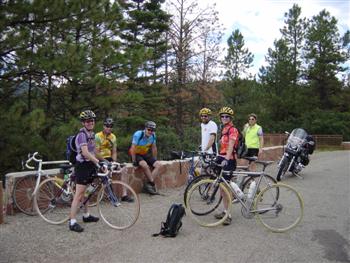
Everyone’s seen them – those people on road bikes with the bright, garish jerseys and the skintight black lycra shorts.  Uptight people are offended and bluster about shameless displays of asses and body fat.  Cyclists at crest of US Hill in New MexicoInsecure men make sarcastic homophobic comments.  A lot of people think the cyclists look ridiculous.  A lot of other people just think the cyclists are weird.  A few people realize what’s really going on.  Cycling apparrel is some of the most functionally designed clothing on the planet.  Everything about it is there because it serves a useful purpose and how well it serves that purpose can sometimes mean the difference between an enjoyable and safe ride or a painful and dangerous one.

If you are new to cycling the first thing you need to do when thinking about wearing cycling clothes is forget about what you look like.  Well-designed cycling clothes are skin tight and very few people look good in skin tight clothes.  Your ass is fat, your thighs are fat, your stomach and hips are fat and there’s no hiding any of it in cycling shorts.  Don’t worry about it.  It’s not about how you look, it’s about how you ride.

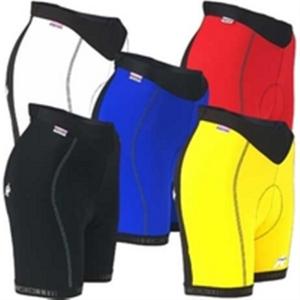
Cycling shorts aren’t absolutely necessary but they are strongly recommended.  When considering the benefits provided by cycling shorts it’s important to think about what’s going on with your legs, ass and crotch when Women's cycling shorts - picture from coloradocyclist.comyou’re riding.  You spend most of your time on the bike seated on the saddle with your legs pumping up and down.  Every up-and-down motion produces friction and rubbing where your ass, crotch and thighs are in contact with the saddle.  The typical recommendation for road riders is to try and maintain a cadence of 85 to 105 revolutions per minute.  Say you’re a new rider, however and are riding at a cadence of 60.  That means your legs are going up and down 3600 times during an hour of riding.  A tiny amount of rubbing or chafing where your body meets the saddle that would be unnoticeable when repeated one or two hundred times can develop into raw, abraded skin that can range from uncomfortable to very painful after thousands of repetitions.  Keep in mind that 3600 repetitions of the same movment is a conservative estimate.  Two hours on the bike at a cadence of 90 produces 10,800 repetitions.

Cycling shorts are designed to minimize or eliminate chafing and rubbing.  Regular pants and shorts usually have a seam that runs front-to-back through the crotch.  If you ride wearing regular clothing this seam will produce rubbing and chafing and will put extra pressure on sensitve areas in the crotch.  Cycling shorts also have a seam down the center but the rider is protected by padding on the inside of the shorts.  Good cycling shorts will have a padded crotch that is usually supplemented with additional padding on the sit bones (the bones in the pelvis that bear much of the rider’s weight when properly seated on a bicycle saddle).  The padding not only cushions the rider but protects from abrasions caused by the seams in the shorts.

The skin tight fit of the shorts is also designed to eliminate chafing.  Loose fitting shorts can crease or bunch up between the rider and the saddle.  Every tiny crease can produce raw, abraded skin.  Loose shorts or pants will also introduce an additional source of friction and rubbing as the material of the clothing slides and moves between the rider and the saddle.  Bicycle shorts are designed to be skin tight to eliminate these two problems.  They are too tight to crease and bunch up and they are too tight to slide between the rider and the seat. 

Cycling shorts also fill an additional and very important function – they wick moisture away from the skin.  Think about what the environment is like in your crotch while you’re riding.  Hot, wet and dark.  Germs love this environment, they thrive there.  If you ride even semi-regularly it’s virtually impossible to completely avoid some degree of chafing.  Infection can turn a slight abrasion that is no more than a minor, short-lived irritant into a nightmare.  Cycling shorts are the single best thing you can do to prevent this from happening.

Cycling shorts cover a broad price range from the very cheap to the very expensive.  Like all cycling gear, I expect you reach a point of rapidly diminishing returns before you get to the most expensive shorts.  That being said, I wear fairly expensive shorts because I’ve had my crotch torn up by wearing cheap, poorly fitting shorts on a long ride.  That’s a mistake you only make one time.  There’s no particular brand or model that can be recommended to everyone because comfort depends on how the construction of the short matches up with the rider’s anatomy.  Shorts come in men’s and women’s models but some women wear men’s shorts and vice-versa because it’s more comfortable.  It doesn’t matter what the manufacturer calls it, it matters how comfortable you are wearing it.

When you buy shorts, start by following the manufacturer’s recommendations vis-a-vis size and fit.  Remember that a little too tight is better than a little too loose.  You wear cycling shorts without underwear.  In most cases underwear will completely defeat most of the benefits cycling shorts are designed to provide: underwear has abraiding seams, it holds moisture rather than wick it away, and it produces slippage and extra friction between the rider and the saddle.  Even if you wear underwear that you think doesn’t have these problems, don’t wear it with cycling shorts.  Never wear unwashed shorts, there are germs in there just waiting to attack your crotch.  Wash the shorts after every use

Cycling jerseys are not as essential as shorts but they are very useful.  They’re designed to be form fitting for two reasons.  Like shorts, they’re made of a wicking material that draws moisture away from the rider’s Cycling jersey - picture from performancebike.comtorso.  This plays a very important role in keeping the rider cool.  When you exercise you generate heat and the body works hard (and burns calories) to shed this heat in order to keep core body temperature within a safe range.  Sweating is an essential part of this process.  When the sweat evaporates it helps cool the body.  Form fitting clothing that wicks the sweat away from the skin surface facilitates evaporation and hence cooling.  More efficient cooling helps to prevent dehydration from excessive sweating and dehydration can be deadly.  Literally, deadly. 

The second reason jerseys are form fitting is to reduce air resistance.  The faster you go, the greater proportion of the energy you’re expending is being used to overcome air resistance.  Loose fitting clothing increases air resistance and at higher speeds can make cycling much more difficult than it needs to be.

In many ways the most important function served by the jersey is related to safety for cyclists who share the road with cars.  Bright, loud jerseys are designed to attract attention.  Specifically, they’re designed to make the rider easier to see by someone who is driving a car.  Far and away the most important source of danger facing the cyclist who rides with traffic of any kind is that the driver doesn’t see the cyclist.  Jerseys are designed to help overcome this problem.  When choosing a jersey, don’t pick colors or patterns that blend in with your surroundings.  Be loud.  It’s not about how you look, it’s about not being hit by a car.

An undergarment or base layer can be worn under a jersey and often should be if cycling in cool or cold conditions.  The undershirt should be skin tight and made of a wicking material.  Don’t wear a cotton t-shirt under a jersey.  Likewise, sports bras that wick are good, regular bras that don’t wick are not.

It used to be that all cycling jerseys were cut pretty much the same way.  Recently, however, jersey manufacturers have begun producing different jerseys for the American and European markets.  In Europe where cycling is much more popular than it is in the US and many more people both ride and are knowledgeable about cycling, jerseys are cut the way they’ve always been.  For the US market where people tend to be less knowledgeable about cycling, fatter, and more concerned with how they look on the bike, jereseys are often cut more full in the waist.   If the description of the jersey says soomething like “European cut” this is what they’re talking about.

While neither are as essential as a cycling helmet, cycling shorts and jerseys serve very useful and important functions.  Of the two, the shorts are more important for making the ride more comfortable and for keeping you on the bike longer today and making it easier to get back on the bike tomorrow.  They’re not designed to make you look good, they’re designed to make your ride easier, safer and more enjoyable.