Many new cyclists or cyclists who are thinking about using their bike to commute to work are anxious about riding in the road with traffic. It’s not as scary as it looks and in many circumstances riding with  cars is actually safer than riding in segregated bicycle lanes or what are euphimistically called “bicycle paths”. If you’re going to be at all serious about road cycling or are going to commute to work you are going to have to share the road with cars. How to ride a bike in traffic can be a controversial topic that generates discussions informed by passionately held ideologies and beliefs. The advice and opinions expressed here are based on many years and tens of thousands of miles spent sharing the road with cars. I ride with cars every day and I don’t want to be killed, maimed or seriously injured on the bike. These are some of the ways I’ve found to most effectively accomplish those things. Keep in mind that there are no hard and fast rules about riding in traffic. You have to evaluate and adapt to each situation separately. Riding safely with cars involves riding the line and riding defensively among other things.
The first question you have to ask if you’re going to ride in the road with cars is where in the road you should ride. People who are not used to riding with traffic are likely to say, “as far away from the traffic as I can get.” That seems like it makes sense but in most cases it’s exactly the wrong thing to do. Why is that? One of the most important things to keep in mind when sharing the road with cars, maybe the most important thing, is that it is absolutely essential that the drivers of the cars see you and be aware of you. This seems so obvious that you might wonder why it needs to be mentioned at all. The reason is that drivers generally aren’t looking for cyclists, they’re looking for other cars, and it’s very easy not to be aware of something that’s right in front of you when you’re looking for something else. To see a terrific example of what I’m talking about, check out this video. It’s only about a minute long and it’s very cool. . . . . See what I mean? You’re already wearing that bright and garish jersey to make yourself more visible to the drivers, you also need to ride where they have a better chance of both seeing you and being aware of you.
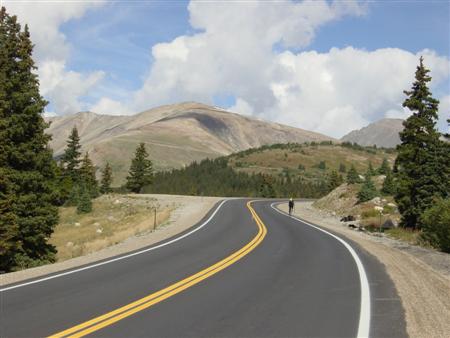
So where should you ride? On the outer (right hand) edge of the driving lane, not on the outer edge of the road near the curb. Many roads have a solid white line that separates the roadway from the shoulder. You should ride as close to that white line as you can. Depending on road conditions and the width of the shoulder, you can ride on either the roadway side of the line with the cars or the shoulder side of the line but you should try to stay close to the line. It’s also a good idea not to get in the habit of riding directly on the line. Road markings are usually made using a plastic or epoxy based paint and they get slippery when wet. You’re more likely to have your wheels suddenly go out from under you on a wet road when you’re riding over the painted lines on the road. If you get in the habit of riding directly on the painted line in dry conditions, you’re likely to unthinkingly ride on the painted line when the road is wet as well. Practice riding to either side of the line.
 On a road with a paved shoulder of even a few feet, the closer you ride to the outside edge of the roadway, the further you move away from the area of the road the driver is watching. The drivers may be able to see you but they will be less likely to be aware of you. In addition, the closer you get to the edge of the roadway the more likely you are to run into road debris like stones, rocks, gravel, sand, sticks, glass, garbage, bits and pieces of metal and other junk that has been swept to the side of the road by rain and passing cars. Riding through this stuff is dangerous and you want to avoid it whenever possible.
Unless a road is extremely narrow, traffic lanes are usually wide enough for a car to comfortably pass you when you are riding on the road side of the line. On roads with virtually no paved shoulder like the one in  the picture at the left, you have no choice but to ride on the road side of the line. However, even this country road is wide enough that passing shouldn’t be a problem. If there is no line at the side of the road, ride near the outer edge of the roadway but not so close to the edge that you’re having to weave in and out of the traffic lane in order to avoid road debris.
When you’re riding down a street that has an occasional car parked along the side you want to avoid the temptation to weave out to pass the car and then drop back in toward the curb once the parked car is behind you. When you drop in toward the curb the parked car is blocking you from the field of view of drivers who are behind you. If there are several parked cars spaced at intervals along the side of the road, a rider who weaves in and out to pass the cars is popping in and out of the driver’s field of vision and this can be very dangerous for the cyclist. The solution is to ride far enough into the road to pass the parked cars and stay there. When approaching a parked car, try and see if there is someone sitting in the car who might open a driver’s side door and hit you as you go by. People rarely look for cyclists when they’re getting out of their car and this type of collision happens more often than you might think.
Riding near the line is only part of what you can do to maximize your safety when sharing the road with cars. How you ride the line is also important. You want to ride a smooth, steady line without weaving back and forth. There are several reasons for this. If you’re weaving around you may be pulling out of the driver’s zone of awareness when you go one way and into the line of traffic when you go the other. Another benefit of riding a smooth, straight line is that it gives the driver coming up behind you confidence that you know what you’re doing so that they can reliably predict where you’re going to be when they pass you. Think about what’s it’s like when you’re driving and come up behind a cyclist. If the bike rider is wobbling all over the place, passing them can be a nerve-wracking experience. If they’re riding straight and sure, passing is usually no problem.
Holding to a straight, sure line when you ride is a valuable skill for the road cyclist to have for many reasons and one of the best ways to practice this skill is by riding the line along the side of the road. Part of this skill involves learning to turn and look back over your shoulder to see what’s behind you without straying from your straight line. When you turn to look over your shoulder, there’s a tendency to drift in the direction you’re looking which means drifting into the line of traffic. You can practice line riding skills like looking over your shoulder when you’re riding the line and there’s no traffic behind you.
Remember that the drivers don’t want to hit you almost as much as you don’t want to be hit. You can make their job easier and increase your level of safety by riding the line in a straight, smooth and sure fashion.
 Insecure men make sarcastic homophobic comments. A lot of people think the cyclists look ridiculous. A lot of other people just think the cyclists are weird. A few people realize what’s really going on. Cycling apparrel is some of the most functionally designed clothing on the planet. Everything about it is there because it serves a useful purpose and how well it serves that purpose can sometimes mean the difference between an enjoyable and safe ride or a painful and dangerous one.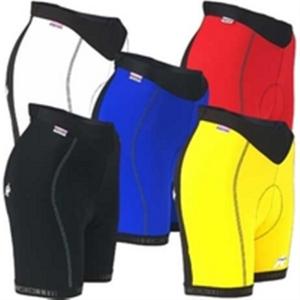

 Tuned In To Cycling