More information about the basics of fueling the muscles and hydration can be found in Nutrition for Cyclists: Eating and Drinking Before, During and After the Ride which can be purchased on Amazon.com. For information about the book and how it relates to what I’ve posted to Tuned In To Cycling, please check out this post.
While proper nutrition is one of the most important factors affecting long-distance cycling on a day-in, day-out basis, there is so much misinformation out there that knowing what to eat and when to eat it can be  difficult. Part of the reason for this is that it’s early days yet for nutrition science; much remains to be learned and nutritional theories are often revised as new information becomes available. Another reason is that the subject of sports nutrition is confused in the minds of many with the subject of dieting. Unfortunately, dieting in the US is a multimillion dollar industry that is fat with fads and outright foolishness. Finally, many cyclists seem to have a deep emotional commitment to their cycling-related eating habits and resist change. In these Cycling Nutrition posts I’ll try to present nutritional information that is based on research found in peer-reviewed scientific journals on nutrition and cycling and endurance sports in general. In this post we look at the basics of how muscles are fueled that underlie every discussion of nutrition for cyclists. In other posts we examine eating during a ride, eating after the ride, and bonking.
Muscles burn glucose for energy. The longer you ride or the faster you ride, the more glucose your muscles need for fuel. When you get on the bike and start pedaling, the demand for glucose for your leg muscles increases and a signal goes out to the body to start supplying the glucose you need.

Where does the glucose come from? The body doesn’t store raw glucose. Instead, it makes glucose from other substances. Glucose can be derived from breaking down stored fat and protein. Subcutaneous fat (the excess fat stored under the skin) is an especially good energy source because fat contains roughly twice the number of calories as either protein or carbohydrate. This means you get more fuel in the form of blood glucose from breaking down a gram of fat than from a gram of either protein or carbohydrate. Indeed, breaking down stored fat to increase the level of blood glucose is the reason why exercise leads to weight loss. The problem with relying on breaking down fat to produce glucose is that the process is relatively slow and energy intensive. Metabolizing (breaking down) fat can be a useful long term source of energy but it is too slow and inefficient to support immediate and short term demands for glucose to fuel ongoing athletic activity.
In order to have fast access to glucose when needed, excess glucose in the blood is stored in a form known as glycogen. Glycogen can be quickly broken down to supply glucose as needed. The main storage locations for glycogen in the body are the muscles and the liver. Liver glycogen is volatile in the sense that it doesn’t last long. This is because liver glycogen serves as an energy source for the entire body. When liver glycogen is metabolized the glucose that is produced enters the blood stream and can be used any place in the body where it’s needed. If you go to bed with with liver glycogen stored at maximum capacity, a large proportion of it will be gone when when you wake up because it was used to fuel the body’s needs while you slept.
Muscle glycogen is more stable in the sense that once stored it remains in place much longer. This is because muscle glycogen does not enter the bloodstream. The glycogen stored in an individual muscle can only provide glucose for that muscle.
So, you’re pedaling along burning glucose derived from glycogen stored in your liver and your cycling muscles and everything’s just peachy. Until you run out of stored glycogen. The body can store enough glycogen to support approximately 90 minutes of moderate intensity exercise. What happens when that glycogen is used up? Where do your muscles get the glucose they need to keep working? Some of it can come from fat that has been slowly breaking down while you’ve been riding but that won’t be enough to supply your needs. Once you’ve exhausted your glycogen stores, most of the glucose you need is going to come from what you’ve been eating and drinking during the ride. This is where carbohydrates enter the picture.
Basic nutrition for any endurance sport such as cycling is primarily about carbohydrates for the simple reason that carbs can be broken down to supply glucose much more quickly and efficiently than either fats or proteans. While you’re on the bike you need a steady supply of carbs to both fuel ongoing activity and stretch the time before your stored glycogen is completely exhausted. When you’re off the bike you need carbs to replace the glycogen you burned during the ride you just finished. For anyone engaged in an athletic activity that lasts for 90 minutes or more, carbs are what basic nutrition is all about.

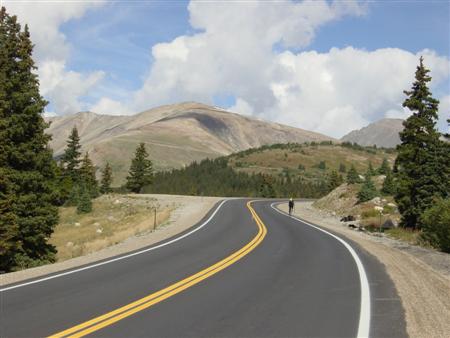

 the picture at the left, you have no choice but to ride on the road side of the line. However, even this country road is wide enough that passing shouldn’t be a problem. If there is no line at the side of the road, ride near the outer edge of the roadway but not so close to the edge that you’re having to weave in and out of the traffic lane in order to avoid road debris.
 Tuned In To Cycling